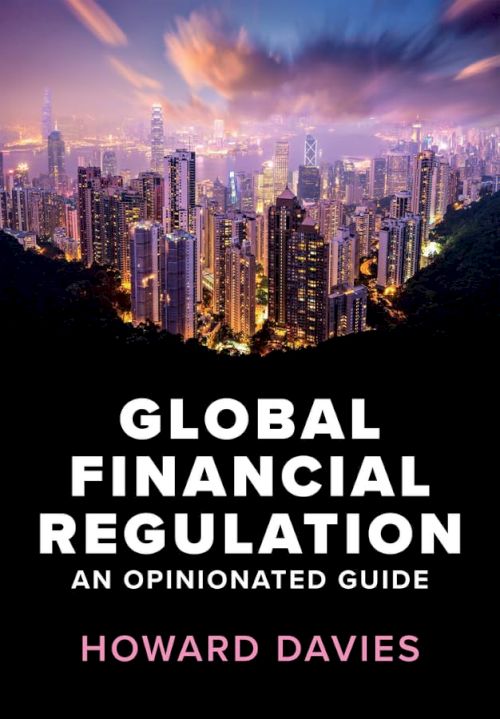
Read the sub-heading of this book’s title again: “An Opinionated Guide”. This book lives up to this pitch. It is not simply a guide to many aspects of global financial regulation but also expresses opinions on the effectiveness of that regulation with clarity and conviction.
The Acknowledgements section notes that this book is a sequel to “Global Financial Regulation: The Essential Guide” written by the author and David Green and published in 2009. The author is well qualified to write on the subject having held executive positions in financial institutions around the globe and was Executive Chair of the UK’s unified financial regulator, the Financial Services Authority.
Many people at whom the book is presumably aimed may have a basic understanding of market regulation. However, when it comes to the regulation of financial markets, particular issues arise. Many markets are regulated but financial markets are regulated “to a far greater degree than most others” (p.13). This is because “There can be externalities generated by financial market activity, which are not easily addressed by private sector actors.”. (p.13). How and by how much to regulate financial markets is a hotly contested topic. Too much regulation is often seen as holding back economic growth. Too little risks financial instability. Opinions and approaches to financial regulation differ between countries. Regulatory competition is common.
Following the global financial crisis of 2008/09, those in favour of greater regulation were in ascendancy. Lately, this has changed. For example, when referring to Europe, the author notes that “the 2024 Draghi report on competitiveness was drafted by a different Draghi than the one who led the European Central Bank (ECB) through a period of rising capital requirements. The tone was very sceptical about the benefits of tight regulation.” (p.14). The reader was warned of opinionated views. You are left with little doubt of the author’s opinion.
The UK does not avoid a withering look. “…regulators have been given a new duty to promote international competitiveness and growth alongside their responsibilities for systemic soundness and consumer protection. The Labour government elected in 2024 doubled down on that Conservative initiative, asking the regulators for other ideas on how to stimulate growth - an odd idea, rather like asking your legal adviser to write you a love poem.” (p.14)
The situation in China, of which the book’s author has experience, is similarly questioned “… the prudential regulators have been brought under more direct political control, in the National Financial Regulatory Administration (NFRA), with unpredictable consequences.” (p.14)
Costly lobbying by banks in the US (they went as far as having TV advertisements in breaks in the Super Bowl (p. 194)) are seen as pushing the Federal Reserve away from forcing banks to have higher capital reserves.
The object of financial regulation should be to provide financial stability, but that is a tricky concept to define. The author provides clarity about this at the beginning of chapter three (p.23). “Financial stability has long been the poor cousin of monetary stability. The latter is easy to define; in recent decades most central banks have adopted an inflation target of two per cent a year. It is similarly straightforward to hold them accountable for its delivery. Financial stability, by contrast, is often defined by its absence.” A simple definition would be “a condition in which the financial system operates smoothly”. A reference to Mishkin fills this out noting “the prevalence of a financial system which is able to ensure, in a lasting way, and without major disruptions, an efficient allocation of savings to investment opportunities.”
The book covers a wide expanse of financial organisations and issues including banks, non-bank financial institutions, sovereign wealth funds, insurance companies, asset managers, securities markets, international payment systems, digital exchanges, anti-money laundering and remuneration limits. There is a panoply of institutions in different countries and in international organisations overseeing and sometimes regulating financial organisations. Responsibilities may overlap. This leads to a complex web of arrangements that is indicated by the six pages at the start of the book listing the acronyms of institutions and laws touched on in the book and by the organograms on page three for international organisations and page 180 for the US. As the author suggests, at least for the US, Heath Robinson would be proud of the arrangements.
But does this fragmented and complex arrangement promote financial stability? The author is not confident. Although requirements for bank capital have increased since the global financial crisis, the author notes “But the 2023 episode, when three mid-sized US banks failed in quick succession, and a G-SIB [Globally Systematically Important Bank] (Credit Suisse) had to be rescued by the Swiss authorities and UBS, showed that problems could still emerge.” (p.51).
When it comes to insurance, the author notes that “Conceptually, Solvency 2 is persuasive but the compliance costs are high, especially for smaller firms.” (p.73) This becomes even more complicated when climate change is affecting the industry. “In Florida thirty insurance companies have failed the last twenty years, largely due to the severity of hurricane-related losses” (p.76). This problem of ‘coverage gaps’ in insurance is not confined to the US. The UK government set up Flood Re to address the possibility of flooding risks in the UK (p. 73).
Problems in the auditing of financial institutions are also noted. “The Audit Reform Lab at the University of Sheffield concludes that ‘the UK audit sector is plagued by poor standards, a toothless regulator, conflicts of interest and weak sanctions for malpractice.’ (p.96). The failure of auditing in Germany with the Wirecard scandal is also cited.
Anti-Money Laundering is noted as “There is no other area of regulation which generates such disagreement - and worse - between banks and their regulators” (p. 133) and when penalties have been imposed on banks in London “In almost every case they have been imposed for the process failings, not related to a specific case of money-laundering.” (p. 135).
I could go on, covering remuneration caps (p.146), appropriate organisational structure of regulators (p. 176) and international payment systems (pp. 197-198).
This reviewer finished the book with a feeling of despair. That despair was not driven by the lack of detail or opinion in the book, but due to its forensic approach. With the AI financing circus in full swing, crypto exchanges being hacked or collapsing, and insurance costs rising for households and businesses there is little doubt that some form of financial challenge is inevitable. It is not clear that the current system of global financial regulation is up to the task of addressing it.
More Book Reviews
All Reviews
Exile Economics: Tariffs, Trade Wars and the Future After Globalisation
Ben Chu addresses the challenge to global trade triggered by Donald Trump’s erratic tariff policy. His background and skills as an economics journalist are...
The Art of Monetary Policy: Lessons from Sun Tzu for Central Banks
This (very short) book extends a lecture given by Forbes, in which she draws on the work of the Chinese philosopher Sun Tzu from the fifth century BC. Sun...
How to Invest: Navigating the Brave New World of Personal Investment
This book provides a lively summary of the latest research into how to invest in an uncertain world, infused with the extensive hands-on experience of the...