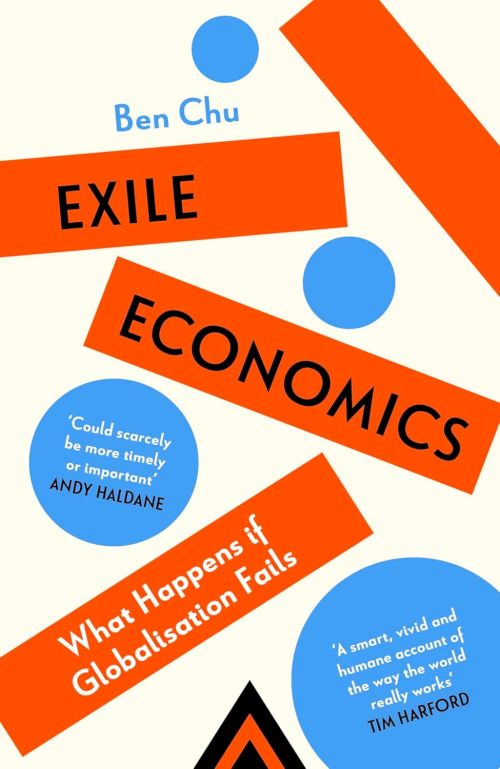
Ben Chu addresses the challenge to global trade triggered by Donald Trump’s erratic tariff policy. His background and skills as an economics journalist are very evident in his book. Facts, analysis and argument are cogently presented in a readable engaging text. The book is well researched, with 65 pages of notes.
In economic theory, trade patterns are determined by comparative advantage. The global supplier offering the best price/performance at any given location wins demand. Welfare theory claims this is a global optimum. It is distorted when governments subsidise their exports, leading to retaliatory tariffs. The contrary argument is for self -sufficiency, exemplified historically by the closed countries of China, Japan and totalitarian states, but also by monasteries, communes, and now by the de-growth environmental movement. Protection of infant industries in developing economies has been prominent. Gandhi, Keynes, and Nyerere also voiced support.
Chu takes us on a fascinating journey through the sectors of food, energy, silicon, people, steel, and medicine. Food self-sufficiency sounds compelling. Emmanuel Macron asked: ‘Who would be foolish enough to outsource their food?’ (p58). But global production of cereals and rice are highly concentrated in a few countries with geographical advantages. A 2020 study estimated that only 25% of the world’s population could feed itself on locally grown cereals, rice and pulses. Similarly, China could only supply a maximum of 42% of its needs for soybeans and has to rely on US and Brazilian production. Since 75% of soybean production is for livestock feed, vegetarianism may reduce demand and hence, trade.
Here, Chu introduces the general challenge to self-sufficiency, that it’s also a question of the value chain. Whilst the US is self-sufficient in food, it depends hugely on imported fertilisers. In the energy sector, the withdrawal of Russian gas led to a scramble to self-sufficiency. Chinese supply of vastly cheaper solar panels, wind turbines, electric vehicles and their batteries came to the rescue. This coincided well with environmental aims but pushed energy dependency up the value chain. The same with critical rare earth minerals. Global dependence on Taiwan chips, Zeiss mirrors, Spruce Pine silicon dioxide is impossible to re-engineer. Global movement of talented people is crucial in many sectors. Self-sufficiency in steel would only increase global over-capacity yet still require iron ore imports. Restructuring the pharmaceuticals sector where a typical vaccine uses 9,000 materials from 300 suppliers in 30 countries is close to impossible. One counter factor which Chu doesn’t mention is that automation may advantage onshoring by reducing the impact of labour cost differentials.
Trumps’s tariffs are erratic, both in rationale and application. They may aim to increase domestic production and employment, but as Chu shows, their effect in advantaging inefficient local producers and increasing domestic prices will make Americans poorer. They may incentivise global manufacturers to shift production to the USA, but not with Trump’s unpredictability. Trump sees tariff revenue alleviating the domestic deficit, a factor Chu doesn’t cover. But for him, tariffs are also a generalised political weapon to be deployed against any country incurring his wrath, or to force that country to buy American, for example persuading India to buy Boeing rather than Airbus planes. His crude power play is impervious to Chu’s refined logic. He does not understand that it’s deficit economy countries which are taking advantage of surplus economies. We should rather ask why the rest of the world is prepared to feed and clothe a consumerist America?
China might soon decide otherwise. China has huge capacity and overproduction. Its 2023 exports of laptops and smartphones exceeded its combined sales of EVs, solar panels, wind turbines and batteries. The core question is whether and when China will increase its own consumer demand and reduce its purchase of US Treasuries to fund US demand for its output. If not, its dominance, for example in EV production threatens to wipe out the European automotive industry. Whilst Chu hopefully cites Pittsburgh as an example of a city which has reinvented itself after rust belt decline, it’s questionable whether such regeneration can apply to the possible devastation of a much wider range of western industrial production. Chu seems not to have considered this fully and consequently offers no resolution.
Chu’s solutions are for governments to map supply chains, stockpile, and diversify their supplier network. His advocacy of globalisation should take more note of the qualifications raised by Joseph Stiglitz in his ‘Globalization and its Discontents’ where he challenges IMF laissez-faire policies imposed in globalisation. Whilst his book is well argued, it lacks a strong conclusion.
More Book Reviews
All Reviews
How to Invest: Navigating the Brave New World of Personal Investment
This book provides a lively summary of the latest research into how to invest in an uncertain world, infused with the extensive hands-on experience of the...
Global Financial Regulation: An Opinionated Guide
Read the sub-heading of this book’s title again: “An Opinionated Guide”. This book lives up to this pitch. It is not simply a guide to many aspects of...
Moral Economics: What Controversial Transactions Reveal About How Markets Work
Moral Economics is an unusual book in the sense that it is a book about the things that we, collectively as a society, have decided at some point in time we do...