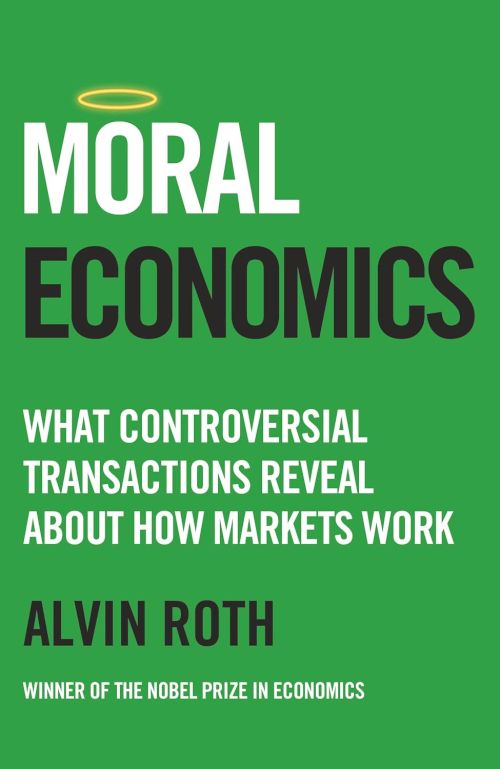
Moral Economics is an unusual book in the sense that it is a book about the things that we, collectively as a society, have decided at some point in time we do not want people to buy, sell, do, or even attempt even when the decisions are made consensually, and willingly. It is a book that tries to tease out the normative economics present from the markets, or lack thereof. This microeconomic and market structure exploration is not something I would naturally have picked up, but I am glad that I did.
Roth is well placed to write it. A Nobel laureate in economics and a Stanford professor, he is best known for market design, and for his role in building Kidney Exchange in the US.
Before he explores the various market phenomena that may or may not help illuminate our societal decisions, and how markets can help fine-tune these decisions to meet the ‘optimal’ solution of helping the most and harming the least, Roth defines a key term. A ‘repugnant’ transaction. He defines it as a transaction where every party directly involved wants to take part, yet others believe it should not be allowed on moral or religious grounds, even though they could not detect it happening unless told. That definition gives the book its overarching focus and narrative through three different markets; intimate affairs, protection from harm, and life and death. Roth provides a refreshing and reasoned account of these debates. Roth does not set out to moralise, judge, or pre-suppose an answer. Rather, he does what economists do best and analyses the trade-offs of banning, regulating, or freeing a transaction.
One of the more striking points to me is how much the exact legal definitions matter. Gay marriage, which falls under the intimate affairs section, is the clearest case. It was considered so repugnant that it barely featured in law at all, because nobody expected it to happen. This initially allowed for gay marriage, but soon laws were enacted to clarify that explicitly banned gay marriage. Law, it turns out, both reflects and constrains how quickly social norms can move.
The book also shows how hard ethics is, and how many “fudges” we make routinely. The example that stuck with me is plasma. Voluntary donation is not enough to meet demand in many countries, so those that ban payment import plasma from countries that allow it. It is hard to see why that is more ethical than permitting payment at home. I am sure there are defences to that view, but they are often unsaid which allows for a ‘wilful’ blindness.
The kidney chapters are the strongest in my view. This is most likely because of Roth’s long personal involvement in the development of the Kidney Exchange programme in the US. Here he raises the question that runs through the whole book: does making something transactional strip away morality and good intention from an action?
Roth argues an impassioned case for regulated markets for most things with clear market design, and a willingness to update the rules over time as evidence comes in: a classic economist approach. He argues that the alternative is black markets, which tend to produce poor outcomes (health, social, and economic) for everyone involved.
Moral Economics will not settle any of these debates and does not pretend to. What it offers is a better way to have them. I recommend it to anyone who wants to think more clearly about contested transactions, and especially to those who suspect that refusing to discuss the trade-offs does not make them disappear.
More Book Reviews
All Reviews
To Think Like a Statistician
Statistics professor Susan Holmes said that statistics is like Poland, perpetually surrounded by powerful neighbours — probability, mathematics, applied...
Exile Economics: Tariffs, Trade Wars and the Future After Globalisation
Ben Chu addresses the challenge to global trade triggered by Donald Trump’s erratic tariff policy. His background and skills as an economics journalist are...
The Art of Monetary Policy: Lessons from Sun Tzu for Central Banks
This (very short) book extends a lecture given by Forbes, in which she draws on the work of the Chinese philosopher Sun Tzu from the fifth century BC. Sun...