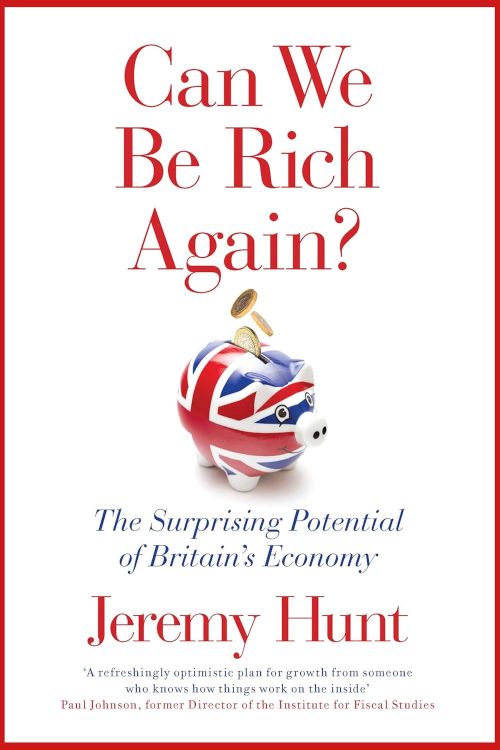
Jeremy Hunt has been culture secretary, heath minister, foreign secretary and most recently Chancellor in Rishi Sunak’s government. His stint at HM Treasury followed the Liz Truss mini-budget debacle when a safe pair of hands was needed to restore the UK’s fiscal credibility. He achieved this: although the premium on gilts remains high today, it did reduce and stabilise following his appointment and budget in October 2022. His Chancellorship came to an end with the general election in 2024 and this book pulls together his experience in that role with some excellent analysis and insights into macro issues and policy in the UK.
It’s an optimistic book which looks at areas where the UK has the potential to adopt policies to increase its growth rate. These are all supply side measures, which makes sense in an economy which is fiscally constrained and has an inflation problem. There are estimates of how much each policy might contribute to the UK’s growth rate and, although the numbers should be treated with a pinch of salt, they do help indicate where the greatest scope for improvement may lie.
The chapters on work and energy are particularly strong. Measures to increase participation in the labour force could yield big benefits for the UK given the drop off since the pandemic. Hunt draws on the experience of Denmark’s childcare policies and higher female participation, and Switzerland’s system of vocational training in getting people back into work.
On energy, where the UK has the highest costs in the G7, there is scope for cheaper bills. The current government is moving in this direction with the approval of the Jackdaw gas field and some measures to speed up grid connections but could go much further in bringing down costs. For example, by looking at how to reduce constraint payments where renewable producers are paid to stay idle.
Sometimes the optimism can be overdone. Yes, the UK is good on innovation and tech and Artificial Intelligence (AI) is one of the biggest contributors to growth on Hunt’s list of reforms. However, there is little on how to cushion the disruption and social impact that he AI revolution will bring before the benefits are felt.
The real challenge though in creating winners in this area is building domestic firms of scale as those with good ideas and products are regularly snapped up by bigger competitors and, more often than not, find themselves relocated to the US. There are strong market forces behind this, but unless they are resisted at a critical stage in a firm’s development the UK will continue to be an incubator, rather than creator of global winners and able to reap the full benefits of growth and employment. The book does not address policies such as regulation to achieve such outcomes.
As an advocate of low tax policies, Jeremy Hunt promotes their benefits as a spur to enterprise and growth, but although countries with strong growth often have low tax takes as a share of national income there is the question of causation.
The book could be more persuasive in this area if it focused more on marginal rather than average tax rates, particularly the high marginal tax rates and cliff edges created by the current system in the UK. These factors do seem to be adversely affecting labour supply and will get worse as more people get dragged into higher tax bands. The section in the book on welfare benefits does show how adverse incentives at the margin can trap those who are out of work.
Overall though the book contains a good discussion on the relationship between the growth and tax, and how economies like the UK are at risk of getting stuck in a low growth-high tax rut.
There are some notable omissions: the book doesn’t address the effect of leaving the EU. Rejoining is not listed as one of the reforms which could boost growth. The author did vote to remain but excuses himself from the debate at an early stage of the book - a reminder that he is still an active politician.
However, he is more forthright on the triple lock which should be replaced by something less generous as “we cannot go on ducking a moral and economic necessity”. He also suggests a powerful fiscal rule not to increase public spending by more than the growth in national income.
This does beg the question as to why he didn’t make these changes whilst in office and, although he admits the benefits of hindsight, it’s hard to avoid the conclusion that our system is not set up to deliver long-term reform. In recent times the Chancellor has had to focus on firefighting in the wake of successive shocks with little time for making structural reforms.
Nonetheless, there is also the sense that politicians simply cannot make such changes, however beneficial, if they wish to stay in office. The unsustainability of the triple lock has been known for some time and well before Mr Hunt became Chancellor, but it has become politically untouchable. Unfortunately, this is one reason why financial crises occur: politicians delay acting until markets force their hand and there is the cover for unpalatable change. A warning of what may lie ahead.
More Book Reviews
All Reviews
The Art of Monetary Policy: Lessons from Sun Tzu for Central Banks
This (very short) book extends a lecture given by Forbes, in which she draws on the work of the Chinese philosopher Sun Tzu from the fifth century BC. Sun...
How to Invest: Navigating the Brave New World of Personal Investment
This book provides a lively summary of the latest research into how to invest in an uncertain world, infused with the extensive hands-on experience of the...

Global Financial Regulation: An Opinionated Guide
Read the sub-heading of this book’s title again: “An Opinionated Guide”. This book lives up to this pitch. It is not simply a guide to many aspects of...