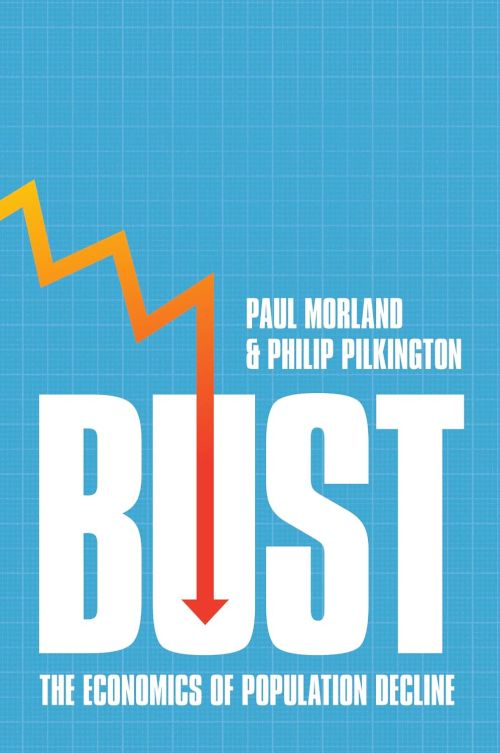
This is a book that argues for a broad package of cultural and policy reforms to stave off the menace of an aging population. In that sense it might be similar to other popular economics books discussing topics like climate change or inequality. What sets it apart are the topic, focus on economics, and the clear high-level story it tells about the risks population ageing poses to societies across the globe.
Most readers of this book review are probably aware that South Korea has the lowest fertility rate of any large country, recently falling to around 0.8 children per woman, and well under the ‘replacement level’ of just over 2 per woman for more than 3 decades. What fewer people may be familiar with is that more than half the world’s countries – covering almost every region outside sub-Saharan Africa and containing over two thirds of the world’s population – now have below replacement fertility, with most of the remainder likely to follow. What happens when smaller generations replace larger ones? And what, if anything, should governments do about it? This book provides at least a starting point to the answers.
A mix of economics and demography, the book also functions as an attempt to re-unite the ‘estranged siblings’ of the authors’ respective fields. As such, it makes for interesting reading on the history of economic thought. The first few chapters cover the basics of demography and the views of thinkers like Smith, Malthus, and Ricardo. I found much of this fascinating, as well as the potted history of the ‘demographic transition’ that seems to universally accompany falling mortality. The writers deliver an approachable introduction to the topic that seems convincing to a non-specialist and which moves relatively briskly through history up to the present day. They deal with most common-sense objections to the trends they identify and explain concepts like the ‘demographic dividend’ as an example of how demographics can drive macroeconomic outcomes – a theme developed later in the book.
Somewhat surprisingly, the authors do not seem to have a single favoured explanation for why fertility has declined so consistently in different times and places, save perhaps with reference to falling child mortality. Rather than focus on the details, their main story is one of transition between a ‘Malthusian’ world of high fertility constrained by scarcity and one where economic growth has removed constraints but people have fewer children with ‘culture’ mattering much more alongside a different set of economic incentives that generally reduce fertility. Exactly why people are having still fewer children now – and fewer than the authors would evidently prefer – is treated relatively lightly. Instead, we move on to the focus of the authors’ story, where it departs from economic history and peers into the future as – in their words – ‘demography drives economics’ in a sharp break with economic history as we know it.
On these implications of a rapidly ageing world, the book is less convincing, but also more thought-provoking. The authors present a ‘through the looking glass’ vision of a world where inflation is structurally higher, innovation is lower, and too much capital is chasing too few productive investment opportunities – leading to an increase in ‘bubbles’ and volatility. The core dynamics of a (temporary) increase in savings, higher pressure on public spending, and persistent labour shortages seem hard to argue with. However, the relative magnitudes of the effects are understandably unclear. The authors describe how a glut of savings as populations age will drive down real rates of return as there are too few profitable opportunities for capital to be employed, and also how higher inflation due to tighter labour markets as well as higher government debt will create pressure for higher nominal interest rates. How these forces interact and balance is not dealt with, and I think the book would have benefitted from an overarching model framework to cover some of these issues. Although, as the authors make clear, in their view many of these questions have long been neglected as the world worried about overpopulation in the second half of the 20th century.
Another area where the authors could have added more detail, which would also likely have supported their case, was on the long-term fiscal implications of an ageing world. I would have welcomed more engagement with the long-term fiscal analysis produced by institutions such as the UK’s Office for Budget Responsibility and the US Congressional Budget Office. This seems like a real weakness to me as their prescriptions for what governments should do are made with only limited reference to the constraints they are likely to face. Instead, the authors focus on the private sector, particularly housing and investment, as well as the damaging political economy consequences of intergenerational conflict.
Japan provides a test case for many of the authors’ arguments, and while parts of the story stack up, the prediction of higher inflation seems to fail. The authors explain this away with a slightly ad hoc seeming mix of bonus pay structure and deferential Japanese culture. I found this unsatisfying, and it highlights the difficulties of forecasting exactly how large macro trends will eventually play out. They have more success in their chapter on housing, where they argue that, alongside restrictions to supply, desire for investment assets has put upwards pressure on rents in many countries that are beginning the transition they describe.
It should also be noted that this book is not intended to be a balanced survey of the literature. Any potential upsides of an ageing society are not discussed. For instance, you occasionally hear it said that an ageing labour force should be good for younger workers who will command a premium, or that the reduced impact on our environment would be a benefit. These objections, alongside the question of automation and higher productivity growth are mostly not addressed or are dismissed with limited reference to data. While remaining economically grounded, the book can also read more like a work of journalism with a chapter on the ‘vampire economy’ and gestures to the idea of a ‘care home gulag archipelago’ as increasingly zero-sum outcomes play out in society.
Avoiding these scenarios is what motivates the authors’ prescriptions. These can best be described as a broad pro-natal shift across government and society. Once again, the focus is big picture, and those looking for a detailed policy package or cost-benefit analysis on different incentive schemes will not find one. Nor do the authors wrestle in depth with questions around targeting first or additional births or how much the state should be prepared to spend on child subsidies. Instead, they make the case for a ‘holistic’ approach, covering family formation, taxation and childcare, and changes to cultural messaging. Some of their suggestions will be controversial. While they advocate for better education around fertility and conception, it is also clear that they see a role for government that goes beyond traditional liberalism in these areas – counterbalancing what they see as excessive anti-natal messaging in many countries.
Overall, Bust is a welcome introduction to an important topic. The sections on demography and economic history are clear and approachable, and the central warning deserves more attention. The authors cover a lot of ground, and where the story lacks detail it is often because the problems they describe are not confined to any one country or set of circumstances. While the book may not fully satisfy those looking either for a textbook or for a detailed package of policies to implement now, this should not stop interested economists from picking it up and engaging with the problems an ageing world is likely to present.
More Book Reviews
All Reviews
Broken China: How the Economic Miracle Shattered and What it Means for the World
China’s rise over the last several decades has been accompanied by an explosion in books seeking to explain its economy and way of doing business to...
The Art of Monetary Policy: Lessons from Sun Tzu for Central Banks
This (very short) book extends a lecture given by Forbes, in which she draws on the work of the Chinese philosopher Sun Tzu from the fifth century BC. Sun...
How to Invest: Navigating the Brave New World of Personal Investment
This book provides a lively summary of the latest research into how to invest in an uncertain world, infused with the extensive hands-on experience of the...