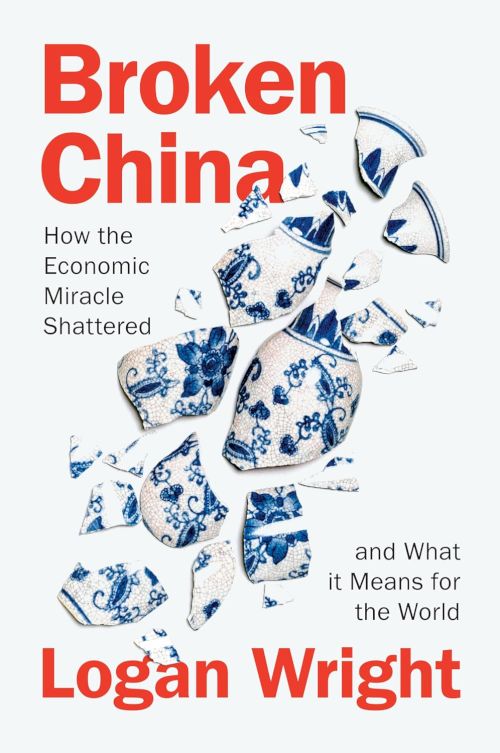
China’s rise over the last several decades has been accompanied by an explosion in books seeking to explain its economy and way of doing business to international audiences. Some have become must-haves for anyone covering the country, including titles such as James Kynge’s China Shakes the World from 2006, or Red Capitalism by Fraser Howie and Carl Walter (2010). Broken China, the new book on the structural weakness of the world’s second-largest economy by Logan Wright, deserves to join their ranks.
Before going on I should declare an interest: Wright has been a friend since my time living in Beijing from 2007 to 2010. I have long found his analysis of China’s economy, mostly published by the Rhodium Group where he is a partner, both useful and persuasive. He has for several years been a sceptic of the sustainability of China’s economic performance, even in the face of the current hyperbole stemming from its growing dominance of certain industries such as electric vehicles and solar panels.
Broken China serves as an excellent summation of Wright’s long-held thesis about China’s economic Achilles heel: the weakness of its financial system. In turn, it should help any reader seeking to understand how China’s economy has functioned in recent years, while it also provides a clear potted history of its policy twists and turns of recent years, in particular from the period after the global financial crisis.
Wright’s basic argument is that the Chinese government’s response to the global downturn from around 2008, followed by an explosion in shadow banking from around 2011, fuelled the country’s investment-led economic growth through much of the 2010s — but ended up creating a debt overhang whose consequences China is still working through today. The figures are indeed staggering: over the eight years following the GFC, China’s banks extended credit equivalent to an “astonishing one-third of global economic output”, Wright writes (his italics).
As time went on, ever more of the debt being issued, mostly by state-owned banks, went into investments generating ever diminishing returns, and into unproductive ‘zombie’ companies and state-owned enterprises. The assumption among investors that Beijing and local governments would stand behind indebted companies to maintain employment levels and tax revenues meanwhile created moral hazard on a grand scale.
Things started to turn in 2016 when the authorities launched a deleveraging campaign initially targeted at the by-then out-of-control shadow banking industry. That developed into a broader slowdown in the debt boom: by 2025, the annual credit growth rate to households and firms had slowed to 6 percent, down from an average 17.5 percent during the boom years from 2009 to 2016. The retrenchment, along with increasingly strained local government finances, led to a devastating collapse in the all-important property sector: China’s new housing construction dropped by 69 percent in the three-and-a-half years to the end of 2024.
Over the last few years Beijing has meantime failed to undertake the reforms needed to put the country’s economy on a more sustainable footing following the demise of this debt-fuelled investment model. A long-promised effort to expand the share of the economy accounted for by household consumption has never really materialized, nor has there been meaningful reform of the tax and welfare system.
Indeed, one of Wright’s key points is that we should shed our illusions about the far-sightedness of Chinese policymakers whose decisions, he argues, are largely reactive and often inconsistent. An important piece of evidence here is the turnaround in economic policy from the one set out by Xi Jinping at the Third Plenum in 2013, which included a desire for markets to play a ‘decisive’ role in resource allocation. That had completely changed by the time of the equivalent Party meeting in 2024, whose decisions “revealed an entirely different long-term economic strategy for China…focused on innovation in advanced manufacturing and other technologies, with little emphasis on household consumption and continued reliance on exports to power growth.”
With the bill for all the past bad lending coming due, one challenge China now faces is “how to decide which lenders and investors will be repaid”, Wright argues. As I write, one example of this is playing out with the story of Zhuhai Guafa, a Guangdong-based local government-owned company which has recently missed debt payments. Credit markets face a painful adjustment as assumptions about the extent to which the state will prop up companies it owns have to be reassessed.
There is plenty more to Wright’s tale, including his analysis of why Xi Jinping’s dominance over decision-making, compared with the more collective leadership under his immediate predecessors, has led to policy errors and damaging unpredictability.
Observers impressed by China’s remarkable advances in industries from robotics to AI may counter that this is all unduly negative. Wright’s argument is that growth in such industries is unlikely to compensate for the property sector slowdown in the aggregate. Indeed, if robots and AI do replace workers, that may merely add to China’s already big problem with youth unemployment and do little to bolster household spending.
Another potential pushback on the idea that China’s economic model is broken, rather than this all being a cyclical problem, is that official data continues to show GDP growth at around the government’s target of about 4.5-5 percent per year — a rate to make many developed economies jealous. Wright devotes a chapter to analysing why growth is likely far lower than official figures suggest and is critical of bodies like the IMF for putting too much credence in Chinese data.
The book’s last two chapters deal with the implications of China’s broken economic model: first for the country itself, and second for the global economy. Indeed, there are surely important implications from the book’s argument for policy makers in major Western capitals. One danger is that if the Chinese economy really is as weak as Wright argues, Xi and other leaders will become more repressive at home as the CCP’s implicit promise of ever-improving living standards in return for its continuing rule fades; and more aggressive abroad to stir up nationalist sentiment.
There may be upsides, too, if Wright is correct, as governments start to realise that Xi, the CCP and China in general may all be more vulnerable than many have assumed. Seen from this perspective, China’s export boom may in fact be a sign of its economy’s fundamental weakness, for example. That realization could in turn encourage leaders elsewhere to push back harder on China’s unfair trade practices — as Europe’s leaders have recently begun to do — with Beijing likely to make concessions for fear of losing its main remaining major engine of growth altogether. Placing a bet that China is less strong than it appears on the surface comes with high stakes, for sure: Broken China makes a convincing case that it would be a justified gamble.
More Book Reviews
All Reviews
To Think Like a Statistician
Statistics professor Susan Holmes said that statistics is like Poland, perpetually surrounded by powerful neighbours — probability, mathematics, applied...
Exile Economics: Tariffs, Trade Wars and the Future After Globalisation
Ben Chu addresses the challenge to global trade triggered by Donald Trump’s erratic tariff policy. His background and skills as an economics journalist are...
The Art of Monetary Policy: Lessons from Sun Tzu for Central Banks
This (very short) book extends a lecture given by Forbes, in which she draws on the work of the Chinese philosopher Sun Tzu from the fifth century BC. Sun...