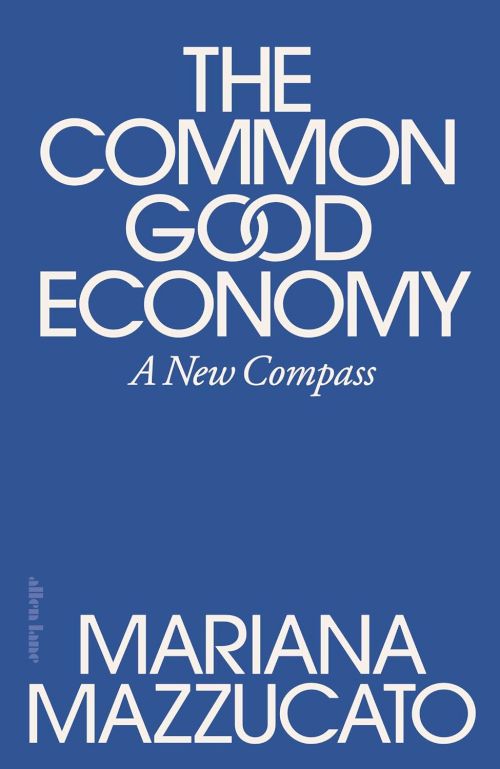
I was looking forward to reading this one. Mariana Mazzucato’s earlier book The Entrepreneurial State sits proudly on my shelf, between my copies of JM Keynes and Kate Raworth.
And I’m not the only Mazzucato superfan. The Entrepreneurial State was highly praised by economists for challenging the status quo, especially the stale assumption that the private sector is responsible for wealth creation, with the state only a secondary actor to regulate, deliver public goods, and correct market failures. Instead, Mazzucato flipped the script and showed how public investment and risk-taking have helped create technologies and new commercial opportunities (subsequently exploited by the private sector).
After that, Mission Economy took Mazzucato’s thesis a step further. It asked how governments might organise the economy around collective goals, rather than treating GDP as an end in itself. Consequently, I was delighted to receive a copy of her latest, The Common Good Economy, for review. But the niggling question in the back of my mind was whether it would meaningfully advance Mazzucato’s argument or merely synthesise her earlier work.
Mazzucato’s ambition is for economists to rethink the purpose of economic activity; to move beyond the national accounts and think more broadly about social progress. This is not an argument that governments should spend more, or that markets sometimes fail. Her thesis is that economic institutions, incentives, and decision-making should be shaped around collective purpose.
It’s an attractive ambition. But economists have raised several challenges. The first is about cost. Can we afford new public investment programmes at a time when fiscal space is limited, bond yields are rising, and interest rates seem to be higher-for-longer?
Mazzucato answers that public spending should not be seen just as a cost. Instead, it can create productive capacity, generate innovation, and produce social returns that conventional accounting overlooks.
I find this conceptually persuasive, but the financing question remains. Consider an investment that generates enormous social value without producing commensurate tax receipts (for example, restoring peatlands or other natural flood defences). How should a government with high borrowing costs and debt-service obligations fund it? A convincing theory of public investment must confront the price of capital. The policy mistakes and missed opportunities of the austerity years do not, unfortunately, invalidate the financing constraints G7 governments face today.
The second objection from economists concerns how to prioritise goals. Suppose Mazzucato is correct that governments should pursue the common good. What happens when several legitimate objectives compete? Defence or decarbonisation? Healthcare or housing? Technology or teachers? All these goals can be justified, but they compete for finite money, workers, materials, and political attention.
Mazzucato’s emphasis on collective purpose helps articulate what governments are trying to achieve (the mission). But it offers less guidance on how to prioritise between competing projects. I agree with Mazzucato that conventional cost-benefit analysis is an imperfect answer, relying on contestable assumptions and struggling to capture social benefits. Yet abandoning it doesn’t remove the need to choose between competing claims on scarce resources. A theory of value creation is not a theory of resource allocation.
The third objection is whether, even if a programme is affordable and desirable, the state can actually deliver it. Public missions require expertise, capable institutions, effective project management, coordination across departments, skilled workers, and, in some cases, entirely new supply chains. The state cannot acquire these capabilities merely by adopting ambitious objectives. A theory of state-led value creation must therefore explain not only what governments should do, but how they can build the capacity to do it.
Most of these objections remain unresolved after reading the book. And I wonder if there is a new, fourth objection to Mazzucato’s thesis. Even if her synthesised argument is persuasive, how much does it really add to what we already know? Versus, say, Galbraith’s The Affluent Society or Will Hutton’s The State We’re In?
Now, the arguments of those authors are not identical to Mazzucato’s. Nor was either the first to question market fundamentalism. But they are part of a modern intellectual tradition which scrutinises the relationship between markets, governments and the public interest.
What is Mazzucato’s latest adding to that? Her distinctive contribution is not simply that the state matters. It is her emphasis on the state’s role in creating and shaping markets, directing innovation and taking risks that the private sector won’t. She also thinks hard about how the rewards from collectively financed innovation should be distributed. This is a substantial contribution. But because The Common Good Economy adopts a broader remit, I think it’s harder to identify what’s new.
Repetition doesn’t mean redundancy. I enjoyed Top Gun: Maverick, even though it did little to advance Western cinema. For someone who hadn’t seen the original movie, I imagine it was an exhilarating watch. The same may be true here. If Professor Mazzucato’s latest makes the argument for the common good accessible to a new generation, that would be wonderful. I hope newcomers to her ideas read it, and that it finds its way onto public-policy economics courses. For my part, though, it’s The Entrepreneurial State that will retain pride of place on my bookshelf.
More Book Reviews
All Reviews
Bust: The Economics of Population Decline
This is a book that argues for a broad package of cultural and policy reforms to stave off the menace of an aging population. In that sense it might be similar...
To Think Like a Statistician
Statistics professor Susan Holmes said that statistics is like Poland, perpetually surrounded by powerful neighbours — probability, mathematics, applied...
Exile Economics: Tariffs, Trade Wars and the Future After Globalisation
Ben Chu addresses the challenge to global trade triggered by Donald Trump’s erratic tariff policy. His background and skills as an economics journalist are...