The nearest thing to an epiphany I had as a student came when I read an early paper (by Dennis Snower, I think) on the “insider-outsider” model of the labour market.
A scholarship boy from a council estate in deindustrialising South Wales, after school I had helped administer means-tested Supplementary Benefit as a DHSS Clerical Officer. I was not a fan of Mrs Thatcher’s government. I had been carefully backfilling my appreciation of organised labour and its history.
The paper said the unemployed had no union: they were “outside” workers. This was a shock: I hadn’t thought about that. It was obvious, but you could do an economics degree (and probably still can) without anyone pointing it out.
My perspective – and sympathy – shifted overnight. The bromance was over. Managers maximised shareholders’ profit. Unions boosted their members’ real wages. Nobody spoke for the outsiders.
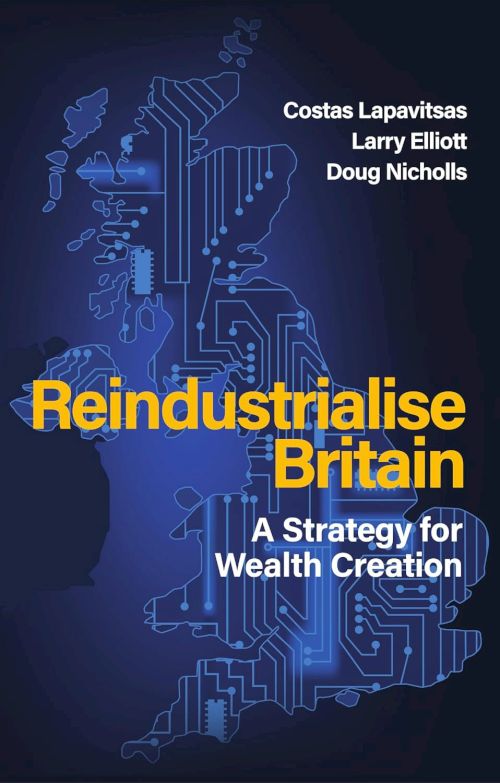
Apologies. I wouldn’t usually start a review with a personal anecdote, but this book, by a professor of economics, a Guardian journalist and a trade unionist respectively, is a polemic, and provokes a response in kind.
It shares with Messrs Trump and Burnham the idea that things were better when basic industries were bigger. It sees unions, investment and the regions as good, and Mrs Thatcher, bankers, consumers and London as bad. Chapter headings include “Neoliberal disaster”, “The world in the slow lane”, “Britain’s lop-sided economy”, “A Green transition and the challenge of capital controls”, “Labour, nationalisation and investment”, “Rebuilding union power”.
Its “strategy for wealth creation” is based on six steps: necessary labour; public ownership; an investment wave; a public bank; trade regulation; and capital controls (pp 109-110).
Specifically, a wall of capital controls, £1.4 trillion of directed investment, and a competitive currency and interest rates, should, the authors suggest, lift the manufacturing sector’s contribution to UK GDP from 8% to 11% (which, I can’t help noting, is where it was in a distinctly postlapsarian 2005).
Reassuringly, if you’re worried about theoretical underpinnings: “The macroeconomic framework underlying our projections draws on the Kalecki-Kaldor analysis of aggregate demand and on Marx’s analysis of accumulation and distribution…” (p 110). We are spared any equations.
On a positive note, the book does recognise that the UK is not the only European economy which has disappointed of late. A “Tobin tax” on financial transactions could make sense – the main objection has arguably been one of practicality. Devolution has indeed been disappointing. Bank of England independence is not costless. The British labour movement is indeed “famously nostalgic” (p156).
And the authors do at least pay some attention to output. They distinguish between “foundational”, “enabling”, “advanced” and “consumer” subsectors within manufacturing.
Overall, though, the book is muddled, clichéd, and mistaken.
For example: despite the long years of current account deficit which the authors bemoan, the UK’s net international liabilities are insignificant. On the same page as an assertion that “British employers have been able for a long time to press real wages downwards” (p75) is a chart showing them to be close to an all-time high. Recent growth in employment is largely ignored (unions don’t represent the unemployed).
In reality, the centre of gravity of the UK economy has always been the south-east, and big finance is not new. The idea that the City rose on the back of the industrial revolution puts the horse before the cart (see “British Imperialism”, Cain and Hopkins, 1993).
As I see things, the modern economy is increasingly intangible, driven by services and digital output. This is probably a good thing (and not just for the environment). It is not a scam, foisted upon a hapless population by Mrs Thatcher, but a reflection of rising – not falling – prosperity. As people’s material needs are met, they spend more on leisure, entertainment, travel, media, computing power (and yes, finance).
Government has a role to play in economic development, but recreating a command economy is not it.
In South East Wales we are using public funds in pursuit of a bigger, fairer and greener economy. Our approach is deliberately eclectic. Often the constraint we face is not finance, but the lack of a compelling business model. Manufacturing is important, but high wage, activity and employment rates will not be delivered by basic industries. We need high productivity businesses, and more foundational employment too. A cynic might note Public that advocates of “reindustrialisation” seem very fond of urging other people to go back to working in mines and steelworks…
I can usually find humour in the public economics debate. You have to laugh, or you’d cry. This book just made me cross. Its simplistic and reactionary assertions are no more an answer to people’s real difficulties than are the fantasies of what the authors would call “the far right”.
More Book Reviews
All Reviews
How To Think About AI: A Guide for the Perplexed
Richard Susskind’s ‘How to Think About AI: A Guide for the Perplexed’ offers a clear and thoughtful introduction to an inherently complex and...

Contingent Expectations
Nearly all important economic decisions depend in some degree on expectations, as opposed to established facts. At the beginning of their new book, Alexander...

To Think Like a Statistician
Statistics professor Susan Holmes said that statistics is like Poland, perpetually surrounded by powerful neighbours — probability, mathematics, applied...