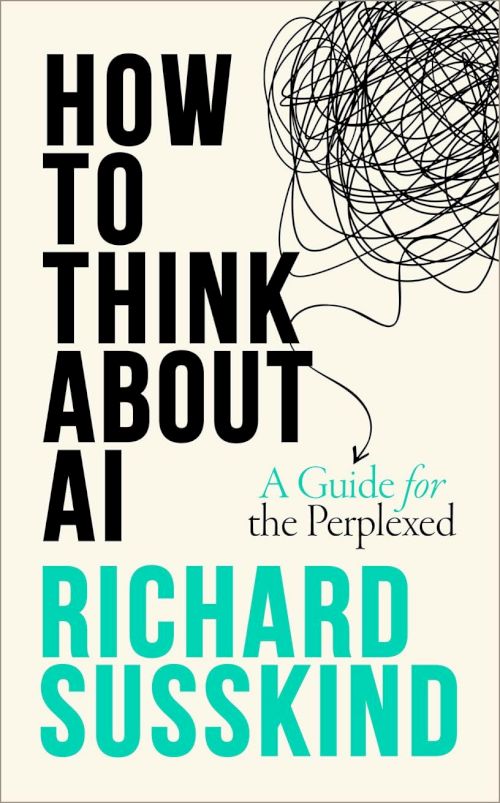
Richard Susskind’s ‘How to Think About AI: A Guide for the Perplexed’ offers a clear and thoughtful introduction to an inherently complex and multi-dimensional issue. Its central virtue is to make the broad area of artificial intelligence accessible through a framework of different elements, each of which is analysed in sufficient depth to be informative to those with little or no technical background in the area.
Susskind’s primary focus, at least in the first half of the book, is on what AI can do rather than how it works. The historical background provides helpful context. AI itself is not new, but prior manifestations were primarily concerned with the simulation of given structures of routine human expert-level thought in automated systems. There was greater scepticism of the view that imagination and creativity could be attained in such systems. By contrast, contemporary AI systems face no anthropomorphic constraints, manipulating extraordinary amounts of data using techniques unrelated to human intelligence. They do not mimic or replicate human reasoning.
He argues that these systems are becoming increasingly capable, already outclassing human abilities, even before the consequences of further exponential growth materialise as a result of further development of enablers such as processing power and storage capacity, and the systems’ ability to ‘self-correct, self-improve and self-extend’. There is no apparent finishing line which sets an ultimate boundary of what can be achieved, but the likelihood is that a widespread transformation of economic and social structures will emerge as technologies unimaginable now become realised.
The book’s greatest strength is its emphasis on consequences. Susskind notes the distinction between process- and outcome- thinkers in AI. The former are interested in how complex systems work, the latter in the results they deliver. Both perspectives are valuable, but he observes pragmatically that ‘we don’t fully understand how our most advanced AI systems work’. As a result, debates about whether machines genuinely understand, reason or are conscious can distract from the effects of their capabilities.
How capable might AI become? Susskind is sceptical that we are close to the end of the road and outlines four possible futures: limited further gains in AI technology, but more widespread use of the technology by firms and individuals; rapid development in AI technology so that it dominates all cognitive tasks; ‘superintelligence’ in which AI becomes unfathomably more capable than humans; and the ‘singularity’ in which humans and AI systems merge. These possible outturns are reviewed fairly, but my paraphrase of Susskind’s position – it’s too early to tell – seems sensible.
His distinction between automation, innovation and elimination is equally useful. AI systems might automate familiar tasks more efficiently. More radically, they can also enable entirely different tasks or remove the circumstances that made particular tasks necessary. The book raises more demanding questions about whether existing professional roles, business models and institutions will remain appropriate as technological capabilities develop. Perhaps one group of readers who should avoid the book are the professionals who, in Susskind’s view vastly overrate the uniqueness of human reasoning and judgements, thereby rendering them vulnerable as these capabilities are increasingly deployed effectively by AI systems.
The later sections in the book address a wide range of important issues associated with AI – for example employment consequences, regulation, risks, machine consciousness, and the future of humanity in an AI-dominated world. These are written as lucidly as previous sections, but I found them more nebulous, unsurprisingly given the speculative nature of much of the ground covered. A lot of ground is covered very quickly. The book is intended as a short introduction, so that it is unfair to expect depth. Nevertheless, I found some of the material too superficial to be of particular value – the philosophical speculation concerning ‘reality’ begs the question of what ‘ultimate reality’ is. In addition, the chapter on consciousness does not address what the concept really refers to and there no support is provided for his instinct that it is in any event too mysterious to be successfully addressed. He does, however, correctly treat consciousness as separate from intelligence: the ‘feeling of what it is like’ is not the same as ‘problem-solving ability’.
The last paragraph contained the usual reviewer’s quibbles, but this should not detract from the overall evaluation of the book. Susskind’s objective of providing an informed and transparent framework to address the key issues in understanding AI from a standing start is clearly met.
More Book Reviews
All Reviews
Contingent Expectations
Nearly all important economic decisions depend in some degree on expectations, as opposed to established facts. At the beginning of their new book, Alexander...
To Think Like a Statistician
Statistics professor Susan Holmes said that statistics is like Poland, perpetually surrounded by powerful neighbours — probability, mathematics, applied...
Exile Economics: Tariffs, Trade Wars and the Future After Globalisation
Ben Chu addresses the challenge to global trade triggered by Donald Trump’s erratic tariff policy. His background and skills as an economics journalist are...