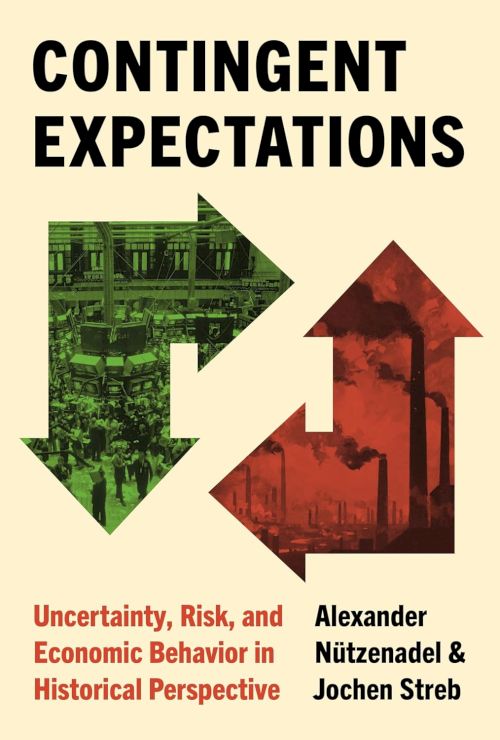
Nearly all important economic decisions depend in some degree on expectations, as opposed to established facts. At the beginning of their new book, Alexander Nützenadel and Jochen Streb identify two theories of expectation formation, both of which they consider unsatisfactory. The older is adaptive expectations: economic actors form their expectations based on a weighted average of their past experiences. The theory of adaptive expectations was soon overshadowed by the more intellectually satisfying theory of rational expectations, articulated in 1961 by John F. Muth. Briefly, ‘the economy, generally, does not waste information’, and ‘rational expectations’ are ‘essentially the same as the predictions of the relevant economic theory.’ As Robert Barro rightly said in 1984, ‘One of the cleverest features of the rational expectations revolution was the appropriation of the term “rational”. Thereby the opponents of this approach were forced into the defensive position of being irrational, or of modelling others as irrational, neither of which are comfortable positions for most economists’. Since then, the rational expectations theory has gone out of fashion, partly owing to the largely-unforeseen financial crisis of 2008 and more fundamentally, owing to the recognition that processing information and using it to form expectations is difficult and costly.
‘Contingent expectations’, as explained by Nützenadel and Streb, are based on the idea that ‘economic agents can and do choose among different ways of forming expectations. In a given decision situation, it is the interplay of several factors that determine the choice of an appropriate expectation formation strategy: the actors’ previous experiences, the cost of acquiring additional information, the variation in possible outcomes of the decision, and the degree of irreducible uncertainty.’ The theory could be used to explain almost any expectation, and it’s hard to imagine that it could ever be proved wrong, but it says little about what the expectations that people form are actually like. The majority of the book is devoted to accounts of how expectations have been formed in specific historical episodes. Thus the subject matter is similar in nature to that of Charles Kindleberger’s ‘Manias, Panics and Crashes’, first published in 1978 and now in its eighth edition. In Nützenadel and Streb’s book, the case studies include the development of insurance, the largely unforeseen outbreak of the First World War, the interwar period, embracing both inflation and the Great Depression, the rise of economic forecasting, post-war inflation and the Phillips curve, the ‘Great Moderation’, and the financial crisis and its aftermath. The case studies are all interesting, and too numerous and extensive for me to comment on them all. So I will confine myself to the issue of inflation.
As the late John Flemming pointed out fifty years ago, the theory of adaptive expectations is incomplete, because it does not specify what variable the expectations are being formed about. But in the macro-economic context, it matters hugely whether adaptive expectations are being formed about the price level or about the rate of inflation (or indeed about the rate of change of inflation). There can be a change of gear, in which expectations shift from being about the price level to being about the rate of inflation, because it has become clear that inflation has become persistent and the price level is trending upwards. At the moment when such a change of gear takes place, there will be an exceptionally large increase in the expected price level.
Such a change of gear must have occurred in Germany after the First World War. In the gold standard era, expectations were surely formed in relation to price levels. However, as the public became accustomed to inflation, expectations would have increasingly been not any longer about the level of prices, but rather about their rate at which they would increase. Not everyone switched their expectations immediately. Interest rates lagged behind the rate of inflation. And, for example, some gullible British investors were induced to buy German marks by advertisements asserting that, sooner or later, the mark was certain to return in value to its pre-war parity. It was this ‘money illusion’ that made the inflation tax so lucrative. The German government exploited such people, as well as people who had no choice but to hold German marks, by printing ever-increasing amounts of currency and using it to make payments.
In the 1960s and 1970s, it was the resurgence of inflation that stimulated the application to macro-economic problems of the theory of rational expectations, which had initially been articulated in a micro-economic context. Specifically, Milton Friedman’s address to the American Economic Association in 1968 made the point that it was absurd to imagine that there was a stable Phillips curve trade-off between unemployment and nominal wage increases, because higher wage increases, if unaccompanied by faster growth of labour productivity, would be accompanied by higher price increases and higher inflation expectations. There was a ‘non-accelerating inflation rate of unemployment’ (NAIRU), and any attempt to drive unemployment lower would lead only to higher inflation.
Of course, Friedman’s diagnosis is consistent with rational expectations, but it doesn’t depend on all of the assumptions of rational expectations. It is also consistent with Nützenadel and Streb’s much less demanding theory of contingent expectations. The important point is that policy makers should not underestimate the perceptiveness of members of the public in matters affecting their own interests. Rational expectations attributes too much wisdom to economic agents, but the Mark 1 Phillips curve attributed too little. There is much other interesting material in Nützenadel and Streb’s book, which is a stimulating and valuable contribution to a very important and difficult subject. The theory of contingent expectations may not have great predictive value, but it passes the common sense test and will not lead economists up blind alleys.
More Book Reviews
All Reviews
How To Think About AI: A Guide for the Perplexed
Richard Susskind’s ‘How to Think About AI: A Guide for the Perplexed’ offers a clear and thoughtful introduction to an inherently complex and...
Reindustrialise Britain: A Strategy for Wealth Creation
The nearest thing to an epiphany I had as a student came when I read an early paper (by Dennis Snower, I think) on the “insider-outsider” model of the...
To Think Like a Statistician
Statistics professor Susan Holmes said that statistics is like Poland, perpetually surrounded by powerful neighbours — probability, mathematics, applied...