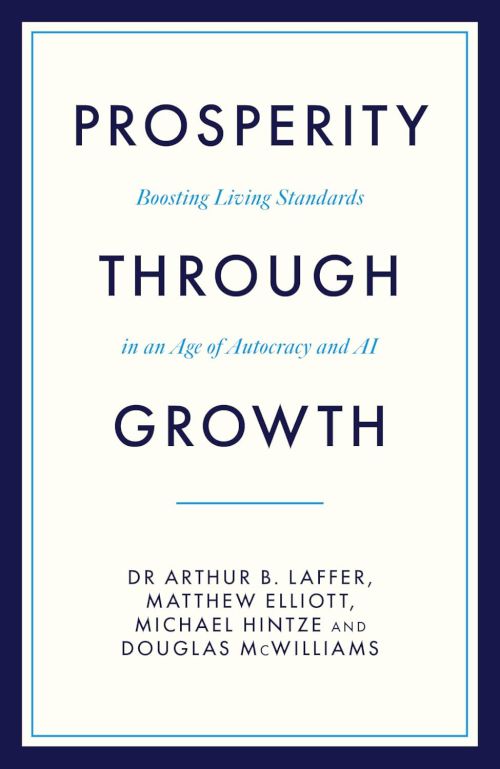
What creates prosperity, and why do countries that have become rich sometimes seem to forget how they got there? We have covered this in previous SPE book reviews and in a number of our Econ Thoughts podcasts. In fact, to paraphrase Rober Lucas ‘once you start thinking about prosperity you cannot think about anything else’. This applies to the US, Europe and the UK. And some may say it should apply particularly to Britain today, where stagnant living standards, weak productivity and an apparently permanent fiscal squeeze have become the background to almost every policy discussion. “Prosperity Through Growth” is an ambitious and unapologetic attempt to answer that question, and to suggest what Britain should do about it.
Ambitious because it tackles the central question of economics and aims to cover both the full theoretical and policy landscape – the five ‘grand kingdoms’ as called by the authors: taxation, government spending, monetary policy, regulation and international trade. Unapologetic because it is very clear about what the ‘North Star’ should be when navigating the journey through the five kingdoms: the ‘North Star’ is a low-rate broad-based tax system, restrained spending, sound money, minimal but effective regulation, and free trade. Prosperity ultimately comes from people working, saving, investing, innovating, trading and taking risks.
The book can be read at three levels. The first is an argument about economic philosophy: what creates prosperity, what obstructs it, and how incentives shape behaviour. The second applies this framework to Britain’s relative economic decline. The third translates it into a programme of 24 reforms, with quantified estimates of their effects. All three deserve attention, although I find them progressively less convincing as we move from principles to diagnosis and then to precise forecasts.
Throughout the book there is a strong emphasis on incentive: taxes change the rewards to work and build businesses; high and unpredictable regulatory costs can prevent worthwhile investments; unstable money impairs the information on which long-term contracts depend; free trade allows specialization, competition and the wider allocation of capital. The authors are not simplistically ‘anti-government’ – they also note that both too little and too much government can damage prosperity, and that well-designed regulation can produce large gains.
At the same time there is a danger in generalizing specific and contextual examples: the claim that redistribution necessarily reduces total output will depend on the tax and transfer design, insurance provided, labour-market circumstances and how public resources are used. The same applies to the book’s invocation of James Mirrlees in favour of a 20 per cent flat tax. His pioneering optimal-tax analysis is relevant but does not establish a timeless optimal rate for every country or every tax base.
The evidence presented is strong but deserves care. The book places considerable weight on the stronger growth of US states without income taxes and on comparisons among post-communist economies. While these are interesting examples, because people and capital can respond to differences in policy, they can also be self-selecting. For example, correlation cannot by itself settle how much of the observed divergence is caused by taxation.
None of this undermines the strongest part of the authors’ argument, which is that incentives matter as much if not more today than in the past. This in part related to two recent and connected changes: the international diffusion of wealth and economic opportunities, which increases the number of countries competing for investment, firms and skilled people; and technological change, particularly AI, which allows work and enterprise to move across borders more easily, while simultaneously shifting the demand for skills. A government may therefore discover that taxes, energy costs or unpredictable rules provoke faster responses than its experience would suggest.
There is, however, a wider story about prosperity. It is not simply the product of ‘correct’ policy settings in the five kingdoms: it is about institutions, trust, education, the accumulation of knowledge and the cultural attitudes supporting innovation and cooperation. Markets depend on rules, and the state can provide public goods that private incentives alone will undersupply.
The second narrative is Britain’s own economic performance. Using CEBR forecasts commissioned for the book, the authors suggest that the UK’s ranking for purchasing-power-adjusted GDP per head could fall from thirtieth in 2024 to forty-sixth by 2050 if policy remains unchanged. However, these are just scenarios and projections, which we all know are likely to be wrong. Nonetheless, they are a useful way of bringing to life a real problem. Applied to Britain, therefore, the framework identifies genuine obstacles. Tax thresholds and cliff edges produce high effective marginal rates; planning delays, permitting and regulatory uncertainty raise the cost of capital-intensive projects; and expensive energy can determine whether industries invest here or move their capital and operation abroad. In the interviews accompanying publication, the book stresses regulatory uncertainty as an indirect cost that can be very damaging.
The more difficult question is whether this diagnosis is sufficiently complete. Britain’s weaknesses also include housing constraints, infrastructure bottlenecks, skills, management and the ability of government to implement its own decisions. These are not always examples of an overactive state. Sometimes they reflect an ineffective one, or a failure to coordinate public investment and private response.
The third part of the book is also its boldest: the ‘24/7 Growth Plan’, with 24 proposals claimed to deliver 7 per cent additional GDP in five years and 29 per cent in twenty. There is merit in making a policy programme concrete, and in considering the combined effect of reforms instead of offering a disconnected wish list. The proposals include tax simplification, a longer-term move towards a flat income tax, abolition of National Insurance, spending restraint and regulatory changes. Both the interaction and the cumulative effect of the proposals and the path to become policy are explored but probably would require a longer treatment and a healthy review and debate. One that hopefully this book would stimulate – rather than being rejected for being deemed too ambitious or simplistic.
The book finally draws on 33 interviews with politicians, officials and business leaders, and these add an important political-economy dimension. Britain does not lack proposals to improve growth; it often lacks the ability to prioritise, implement and sustain them. The fiscal and distributional costs of transition matter because they influence whether reforms can survive long enough to work. Political feasibility is the ultimate litmus test of any policy and the only mechanism through which it can become investment and eventually higher living standards.
On balance this is a very helpful, ambitious – though at times incomplete – companion to the economic debate about how to revive British economy. The authors deserve credit for outlining a specific policy programme, though more work will be required to assess its viability and ultimate effect, and the options proposed will generate debate. In the end, prosperity depends on the interaction of markets, institutions, culture and policy, and on that most will agree.
More Book Reviews
All Reviews
Moral Economics: What Controversial Transactions Reveal About How Markets Work
Moral Economics is an unusual book in the sense that it is a book about the things that we, collectively as a society, have decided at some point in time we do...

A Fabulous Debt: The Epic Story of How Bonds Built the Modern World
With global bond markets making headlines and bond yields at multi-decade highs, the new book by FT Alphaville editor Robin Wigglesworth, “A Fabulous...
The Common Good Economy: A New Compass
I was looking forward to reading this one. Mariana Mazzucato’s earlier book The Entrepreneurial State sits proudly on my shelf, between my copies of JM...