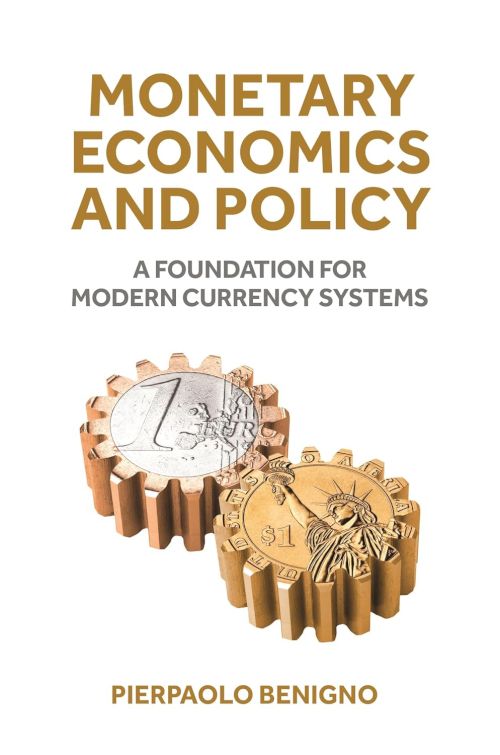
I enjoyed reading this book. It covers a wide surface area of monetary economics, and I think it will be useful for people studying the subject. It is important to say what the book is, and what it is not. This is primarily a book of monetary theory rather than a book explaining the practicalities of monetary policy. It is largely orthodox in its approach, using mathematical models, equilibrium conditions and maximisation to explain the relationships between money, interest rates, prices and economic activity. It is not a book in the style of post-Keynesian monetary theory, modern monetary theory or other alternative approaches to money. It has a slight Austrian school tinge to the models, but it is definitely not a free banking polemic. There are historical examples drawn upon, but it is not a history of money book.
I imagine the book will be read primarily by economics students. The mathematics will discourage the casual reader. This is not a Freakonomics-style book, full of interesting anecdotes and historical facts. For those with an economics background, much of it serves as a useful refresher, with some good new arguments about currency competition and innovation. For somebody beginning the subject, there is an enormous amount to learn.
One of the things I liked most was the inclusion of cryptocurrencies, private money and competition between currencies. There are an enormous number of monetary economics books which simply assume one national currency, and then builds on this, so this was good to see. I also enjoyed the short discussion of the gold standard. The book correctly recognises that prices were comparatively stable over long periods under the gold standard, but unstable in the short run. Its treatment of Gibson’s paradox was another good addition.
One of the problems I had with the book is that it sometimes speaks too confidently about the conclusions of its models. A relationship which follows from a particular set of mathematical assumptions does not necessarily describe what happens in the economy. For example, the book concentrates heavily on consumers choosing how much to spend now and in the future via using a Euler equation when explaining how changes in interest rates affect demand. There are, however, other mechanisms, including commercial bank lending and the creation of bank deposits. Benigno does discuss banking, but I would have liked a fuller comparison of the different mechanisms and the empirical evidence for their importance.
Another area where I am unconvinced is the argument that the central bank’s net asset position affects its ability to control inflation. Benigno provides a model for this, but I do not think the model or the evidence presented is strong enough. A relationship between central bank financial strength and inflation does not establish which is causing which. Higher inflation and interest rates can themselves damage the value of assets held by a central bank. There is also the cost of maintaining large holdings of gold and foreign exchange reserves, which deserves more attention.
The book’s treatment of fiscal dominance is valuable. A central bank can be independent in name but still face pressure to support government debt markets when financial stability is threatened. The issue I had is that the political constraints on fiscal dominance receive too little attention. Governments face electoral consequences from high inflation, high borrowing costs and financial instability. I would also have liked more discussion of current government debt projections and events such as the UK’s 2022 gilt-market crisis.
My largest disagreement concerns currency competition. There are genuine benefits from innovation and giving people alternatives to poorly managed national currencies. But privately created money is also subject to procyclical expansion and contraction, coordination failures, runs and contagion. What is profitable for an individual financial institution is not necessarily best for the economy as a whole. I think the book gives far too little attention to these problems.
I recognise that Benigno cannot cover every complication in a book dealing with such a wide subject, and that he is likely to be familiar with many of the arguments I raise. I enjoyed it, found it useful and would recommend it to people committed to learning monetary theory.
The book ends by saying it would like to see monetary distortions consigned to the pages of history. While I agree that this would be a good thing, I am not sure that increasing currency competition would necessarily be the way to achieve this. I remain concerned that it might produce the opposite outcome, resulting in worse monetary distortions than we see at present.
More Book Reviews
All Reviews
Contingent Expectations
Nearly all important economic decisions depend in some degree on expectations, as opposed to established facts. At the beginning of their new book, Alexander...
Moral Economics: What Controversial Transactions Reveal About How Markets Work
Moral Economics is an unusual book in the sense that it is a book about the things that we, collectively as a society, have decided at some point in time we do...

A Fabulous Debt: The Epic Story of How Bonds Built the Modern World
With global bond markets making headlines and bond yields at multi-decade highs, the new book by FT Alphaville editor Robin Wigglesworth, “A Fabulous...