
16 July 2025
Atlas of Finance
Mapping the Global Story of Money
Dariusz Wójcik, James Cheshire & Oliver Uberti
2024, Yale University Press, 224 pages,
ISBN 9780300253054
Reviewer: Kevin Gardiner, Rothschild & Co / Cardiff Capital Region
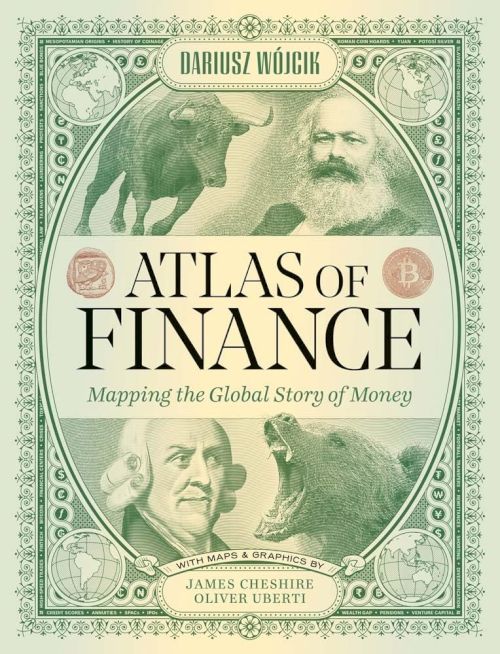
This is a large-format, highly illustrated collection of short essays tackling many geographical aspects of finance. The principal author is a professor of financial geography, and the visually appealing and intriguing book is the product of over 12,000 hours of work in total by him, his fellow named authors, and 200 student interns. Thirty pages of notes, sources and references testify to the work which underpins the project.
The result is an informative, browsable book, but one which is hard to categorise: if economic consultants had waiting rooms, it would happily find a home there.
After a short introduction (“Demystifying Finance”) there are eight sections: “history & geography”; “assets & markets”; “investors & investments”; “intermediation & technology”; “cities & centres”; “bubbles & crises”; “regulation & governance”; “society & environment”. Each section is in turn broken up into ten specific topics, discussed and illustrated usually across two facing pages.
Many of the charts and graphics are ingenious: they sometimes take a while to work out, but units and legends are to hand, if not always where you might expect them, and the designers should be congratulated. That said, for me the topics and spreads do not all work equally convincingly. I thought those on the history of coinage and physical money were informative and lent themselves to imaginative mapping, but the one on short-selling was unclear, and its cartoon poorly chosen. The selection of topics too seemed somewhat arbitrary: Special Purpose Acquisition Companies are much less interesting and important than they sound. For an “Atlas” of finance, there were actually fewer global maps than this cartophile had hoped to see.
The text too is more normative than I might have expected. The authors assume that readers share their value judgements, but even where I did, I found them intrusive here. Cumulatively, those normative remarks suggest that there is something wrong with The System, and it is someone’s fault. But it is perfectly possible, of course, that much of the economic and financial development illustrated here has been ad hoc, and that a counterfactual world without finance and capitalism might be poorer and more unequal.
Nonetheless, the book is full of rich anecdotes and facts that were new to me, and I enjoyed it.