
10 November 2025
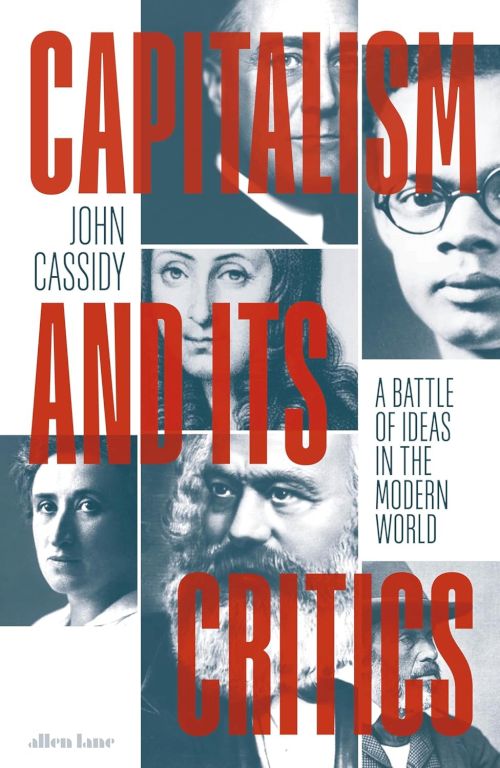
Capitalism and its Critics
A Battle of Ideas in the Modern World
John Cassidy
2025, Penguin Books, 624 pages,
ISBN 9780241457009
Author: John Cassidy
Reviewer: Filippo Gaddo
The punchline in the movie ‘A Knight’s Tale’ – a truly entertaining film – is: “You have been weighed; you have been measured; and you have been found wanting” [The original phrase is actually from the Book of Daniel, which proves that nothing is new under the sun…]. In its first appearance in the movie the line is told by Count Adhemar to the young William Thatcher, though it is later told by … let’s not spoil the movie yet.
John Cassidy’s book “Capitalism and its Critics; a Battle of Ideas in the Modern World” is essentially a weighing and measuring of Capitalism not via data, statistics, equations or econometrics but through the words of its main detractors: students, practitioners and, yes, also of some of its supporters.
As an unabashed supporter of capitalism myself [I disclose my bias here] I wanted not to like the book: how could I like a book that incessantly talks about critiques of Capitalism? But as I went through pages and chapters (and yes, there are lots of both – it is a long book, not an easy read, but it is not tedious, in fact it is compelling and engrossing and the time will go fast as you go through the almost three centuries of critics) I increasingly came to enjoy the reading and ended up really loving the book.
It is well written, scrupulously researched and wide ranging: it gives a voice to famous critics, Carlyle, Engels, Marx, Rosa Luxembourg, Keynes, Stiglitz, Piketty but also less familiar ones, but at the same time no less powerful or cutting, like William Thompson, Flora Tristan, or Nicholas Georgescu-Roegen. There is also space for personalities who would normally be counted as pro-Capitalism, such as Adam Smith, Milton Friedman and Friedrich Hayek. Their criticism is not so much with the concept of capitalism but with some of its mainstream applications and their dismal economic results.
The book is an history of Capitalism through its critics, observers and reformers. It does what is says on the tin very well. But in every chapter as you go through another angle and another argument why this ‘system’ seems to produce so many negative outcomes, there is a sense of something lacking: the voices of the supporters and those who pushed through the policies that defined capitalism in its many facets and manifestations across the globe and over the past three centuries.
Further, it hints at, but does not dwell upon, the explanation of why Capitalism has been effectively so successful over time: not just in advancing material prosperity but also in sustaining liberal–democracy and being accepted in the practice, even if not so much sometimes in the words, by billions of people worldwide. It is a mystery: how capitalism, having so many opponents and faced so many crises and near-death experiences – whether it is the 1930s Great Depression or the 2008 financial crisis – keeps reinventing itself and become even stronger and more resilient. This is not a criticism of the work of Cassidy – that was never going to be the theme of the book: it only points to the need for a counterparty, a mirror to his monumental effort. Maybe an idea for his next book.
In the final chapter of the book, Cassidy deals with the inevitable question of the role that AI and climate change will play in the future of capitalism. If the system is indeed such a formidable and adaptable survival machine, one could expect that it could deal with the current ‘polycrisis’ and the emergence of artificial intelligence in the same way it did before: through adaptation and reforms, incorporating where possible sensible critiques that address externalities and frictions and manages the unpopularity that is generated during times of change.
One other option is for a more fundamental reform of its key components and pillars, whether it is the balance between state and private control of the economy or trade-off between a degree of inequality and productivity growth. The problem with such a view though, and with many of its critics before, is that no other solution has been found yet, despite many being tried. Maybe, Churchill was right after all (duly paraphrased of course): ‘[Capitalism] is the worst form of [economic system] except for all those other forms that have been tried’.
At the end of the movie ‘A Knight’s Tale’ – spoiler alert – it is Thatcher’s (William and not Margaret) time to tell Count Adhemar that he has indeed “been weighed; you have been measured; and you have been found wanting”. After reading the wonderful, bold and compelling book by John Cassidy I can only smile and think that maybe it is capitalism and not its critics that may similarly have the last word.