
25 March 2026
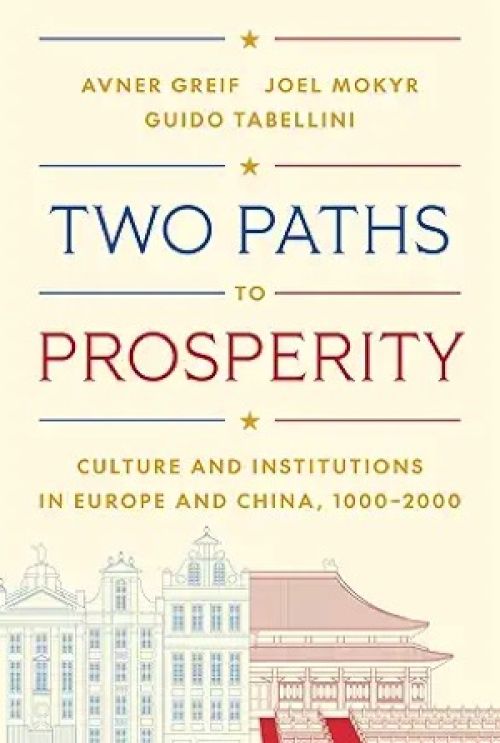
Two Paths to Prosperity
Culture and Institutions in Europe and China, 1000–2000
Avner Greif, Guido Tabellini, and Joel Mokyr
2025, Princeton University Press, 544 pages,
ISBN 9780691265940
Author: Avner Greif, Guido Tabellini, and Joel Mokyr
Reviewer: Filippo Gaddo
A defining book about the cultural foundations of economic growth
There are many books about why Europe industrialised first, though few manage to say something genuinely new. “Two Paths to Prosperity”, by Avner Greif, Guido Tabellini, and Joel Mokyr, certainly does. Its core claim is that the decisive divergence between Europe and China began much earlier than many standard accounts allow (generally at the time of the industrial revolution or just before in the 17th Century), and that it began not with factories, trade routes, or even early modern science, but with different ways of organising society, cooperation, authority, and family life. That makes the book a major contribution not only to economic history, but to the broader argument and understanding about the relationships between culture, institutions, and prosperity.
The book has acquired added weight because it appears in the immediate wake of Joel Mokyr’s 2025 Nobel memorial prize. The official Nobel statement is telling: Mokyr was recognised for identifying the prerequisites for sustained growth through technological progress and for explaining innovation-driven economic growth. His Nobel lecture — “The Past and Future of Innovation: Can Progress be Sustained?”—captured exactly the question that hangs over this book as well. Why do some societies convert bursts of invention into a durable process of innovation and thereby generate prosperity, while others do not?
That question sits inside a long debate. Douglass North made institutions central to long-run economic performance. David Landes revived a more openly cultural explanation of why nations prosper. Hofstede’s national-culture framework, whatever its limitations, helped push culture into comparative social science. More recent work has been more rigorous and more causal: Greif on cultural beliefs and institutional equilibria, Tabellini on culture and development across European regions, Mokyr on useful knowledge and the culture of growth, Bisin and Verdier on cultural transmission, Guiso-Sapienza-Zingales on trust, Gorodnichenko and Roland on individualism and innovation, and Spolaore and Wacziarg on barriers to the diffusion of development. Recent Church-and-kinship research (most notably Henrich 2020 “The WEIRDest people in the World” book) has added another layer by linking family structure to impersonal cooperation. “Two Paths to Prosperity” belongs in that literature, but it also rises above it. It does not merely say that culture matters; it shows how culture gets lodged in concrete organisational forms, and how those forms shape law, politics, and innovation over centuries.
The book’s central contrast is between clans and corporations. In both medieval Europe and China, many public goods were provided outside the state. In China they increasingly came to be supplied by clans: kin-based, hierarchical, morally particularistic bodies well adapted to local welfare, order, and risk-sharing. In Europe, by contrast, weaker kinship ties and a distinctive marriage regime pushed societies toward corporations: monasteries, guilds, communes, universities, and later commercial organisations composed largely of unrelated people and governed by formal rules. The key point is not that one form was “good” and the other “bad.” It is that they solved social problems in different ways, and those differences had enormous long-run consequences.
Identifying the source of ‘prosperity’ in the different organisational and societal structure shows why the real divergence started early. The Middle Ages, not the eighteenth century, are the crucial period. The big later drivers of Europe’s rise—interstate competition [whether driven by geography or the failure of the emergence of a unified central state], the role of the Atlantic trade, the rise of modern science in the wake of the Reformation and Counter-Reformation, the way knowledge was shared through informal organisation such as the Republic of Letters, the alliance of scientists and artisans / practitioners through experimentation, trial and error and market incentives, and eventually industrial capitalism—did not create the difference from scratch. They built on it. Europe was already becoming a world of modular, rule-bound corporate bodies, divided authority, and impersonal trust. China was consolidating a lineage-state equilibrium better suited to stability, hierarchy, and moral enforcement within kin networks. By the time the early modern accelerants arrived, the underlying social architecture already differed profoundly.
The most interesting and potentially provocative part of the story is the role played by the Catholic Church. The Church mattered not simply as a religious actor (and the moral imperatives it imparted to businesses, governments, and society at large), but as an institutional one: it attacked intensive kinship through marriage rules, built canon law, claimed a separate authority distinct from rulers (thus engendering a form of political competition), and acted as what one reviewer aptly called the “mother of all European corporations.” The Church thus appears as the agent that helped break the moral monopoly of kinship and normalise durable organisations outside both family and state. That in turn helped create the legal and moral world in which strangers could cooperate under common rules. The universality of the moral and cultural codes of the Church combined with the fragmenting and competitive dynamics of the political order created the ideal conditions for the emergence of the most appropriate institutions conducive to prosperity. If one were to look for a “secret ingredient,” this is probably it: not culture in the abstract, but a universalistic moral order embodied in corporate forms.
Why did that matter so much? Because corporations scale in a way clans do not. They admit outsiders. They persist through office rather than blood. They require rules, adjudication, and delegated authority. They create habits of impersonal cooperation. In Europe, that helped generate civil law, stronger private organisations, autonomous universities, self-governing towns, and alternative centres of power capable of checking rulers. Europe’s associational world acted as a school for law, property rights, and political pluralism. China’s clan-based order, by contrast, could be highly effective at welfare and coordination, but it was less conducive to building impersonal legal institutions and autonomous bodies capable of repeated, disruptive innovation.
Nonetheless, China’s different historical path to prosperity should not be caricatured. This was not a civilisation without science, administration, or sophistication; it was, for long stretches, the richer and more advanced one. In fact, up to the 16th Century if not until the actual start of the Industrial Revolution, China was – by most metrics – ahead of Europe, or at least the vast majority of European states. Nor does the book deny China’s recent success. Indeed, the late chapters are among its most intriguing because they force the reader to ask how China has managed to narrow the gap so dramatically and so rapidly. The book’s answer is suggestive but somewhat ‘compressed’. It implies that reform-era China achieved rapid catch-up through market opening, state coordination, technology adoption, and administrative capacity, without wholly abandoning older forms of hierarchical and networked social organisation. Some may put the point more starkly: modern Chinese capitalism may have adapted, rather than abolished, kinship-based coordination. That would explain both the speed of China’s rise and the uncertainty about its next phase. Catch-up, adaptation, and large-scale implementation are one thing; sustained frontier innovation is another.
This is a long, well researched, cumulative, learned book, and it takes time to describe and absorb the details of the medieval world out of which the divergence emerged (though patience is a virtue). However, the depth of the setting and the description of the process, also means the book feels comparatively hurried at the end, just when the reader most wants more on China’s present model, Europe’s current anxieties, and the conditions under which prosperous societies remain innovative.
Finally, a comment on the title: “Two Paths to Prosperity” sounds symmetrical. However, the story the book actually tells is more uneven: Europe’s path reaches earlier, deeper, and more sustained prosperity; China’s path yields an early lead, a missed chance, followed by stagnation, long stability, with considerable strength, and now a striking catch-up, but without achieve yet the same level nor on the same scale.
Even so, this is a major path-breaking book. It brings together Greif’s work on culture and institutions, Tabellini’s work on culture and development, and Mokyr’s Nobel-recognised work on innovation and useful knowledge into a single, ambitious synthesis. It will almost certainly become one of the standard reference points for the cultural explanation of long-run prosperity. Whilst a shorter version for general and more harried readers would be welcome, that is a complaint made against many serious books and seldom against mediocre ones. This one is serious in the best sense: bold, learned, and worth wrestling with.