
16 July 2025
Our Dollar, Your Problem
An Insider’s View of Seven Turbulent Decades of Global Finance, and the Road Ahead
Kenneth Rogoff
2025, Yale University Press, 360 pages,
ISBN 9780300275315
Reviewer: Maximilian Magnacca
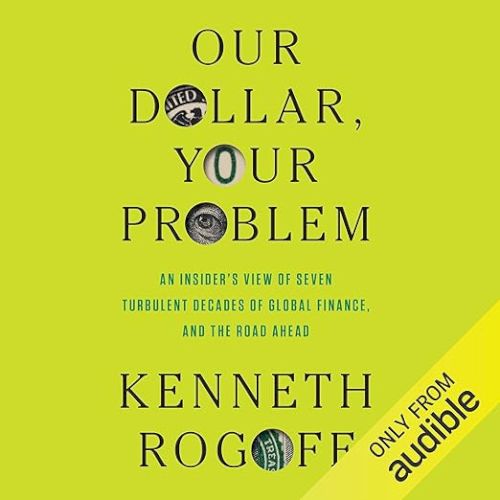
Kenneth Rogoff’s latest work arrives at a particularly crucial moment in monetary, financial, and, potentially, global history. With the election of a new US administration and its whiplash policy announcements undermining previous economic policy orthodoxy, there are intensifying global questions on the dollar’s role in the global trading and financial system. This book by Professor Rogoff provides both timely analysis and timeless insights taking readers through a journey across various reserve currencies in history, potential contenders for the dollar’s current pivotal status, as well as how the dollar could threaten its own status. Rogoff draws on his own experiences as an academic and as a policymaker to deliver an academically rigorous yet entertaining and thought-provoking read.
I found the book’s greatest strengths to be its historical perspective and thoughtful manner. Rogoff effectively reminds readers that reserve currency status is not permanent, tracing how previous dominant currencies lost their privileged positions. This historical context proves useful as he explores the contemporary challenges facing the dollar and the likelihood of it losing its status and of contenders such as the euro or the renminbi taking a global role.
Throughout the book, Rogoff adds to his analysis with personal anecdotes that highlight how these abstract issues often reach the top of political and economic discussions globally. This makes the book more accessible to those who are potentially less familiar with international economics, and more interesting for those who are!
The China question, and whether the renminbi can internationalise, dominates much of the discussion of the alternative to the dollar-based system. Rogoff tackles this head-on, and his analysis reveals why the seemingly compelling arguments for Chinese monetary ascendancy have failed to materialise thus far, such as the managed exchange rate regime, arbitrary rule of law, and a relatively shallow capital markets system all discouraging foreign investors. Additionally, with China’s growth engine sputtering there are also questions over the potential future attractiveness of any global renminbi attempts. However, Rogoff maintains a nuanced view, arguing that given China’s weight in regionalised trade supply chains it is possible that the world will see the dollar lose global status, becoming one of a handful of regional currencies alongside the euro in Europe, the renminbi in Asia, and the dollar in the Americas.
One of the book’s most insightful observations concerns Asian saving patterns and their global implications. Rogoff notes how historically high Asian savings rates have contributed to pushing down global interest rates. This analysis proves particularly prescient when considered alongside demographic trends. As he suggests, we may be witnessing the end of this high-savings era, with aging populations potentially driving interest rates back up as the demographic dividend shrinks, something Charles Goodhart has explored in his book, The Great Demographic Reversal.
Building upon this, Rogoff shifts the focus of the book onto the US and how American policy could undermine the dollar’s global role when done in tandem with changing global savings and the end of the demographic dividend. It is here where Rogoff becomes particularly sharp, criticising American policymakers over US debt management, fiscal deficits, and the undermining of the US Federal Reserve’s independence. Rogoff identifies that the trends of excessive debt levels, misplaced faith by policymakers in permanently low interest rates, fiscal abandon on both sides of the political aisle, as well as increasing appetite for an alternative to the USD-based system are increasingly creating real challenges to the dollar’s status. He is also careful, however, to note that while it is the American dollar, it is the globe’s problem during any transition to a different monetary regime.
In summary, Rogoff has produced a work that successfully balances immediate policy relevance with longer-term strategic thinking for investors, laypeople, and academics. His combination of historical perspective, personal insight, and rigorous analysis makes this essential reading for anyone seeking to understand the forces shaping the global monetary system. At a time when the dollar’s dominance faces unprecedented challenges, this book provides both the context and analytical framework necessary for understanding where we are today, how we got here, and where we might be going next.