
10 November 2025
Crisis Cycle: Challenges, Evolution, and Future of the Euro
John H Cochrane, Luis Garicano and Klaus Masuch
2025, Princeton University Press, 328 pages,
ISBN 9780691271606
Author: John H Cochrane, Luis Garicano and Klaus Masuch
Reviewer: Max Magnacca
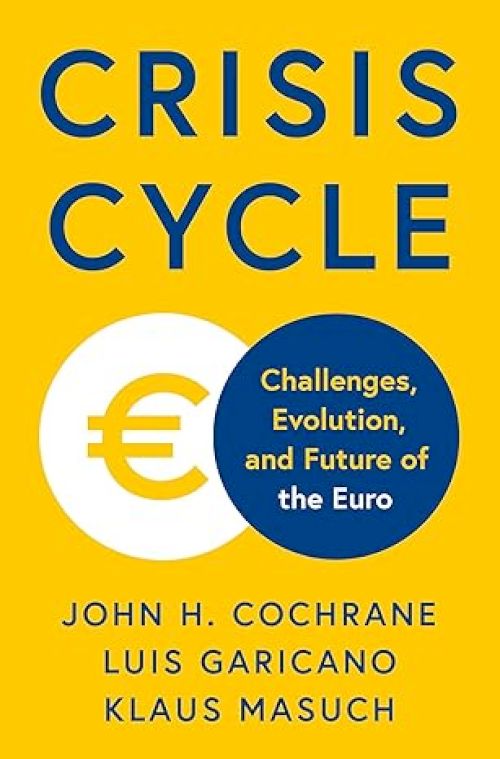
This book tackles one of the most pressing and perennial questions facing the European Union: can the euro survive in its current form, and if not, what needs to change? This question has had many authors attempt to cover it, but the attempt by John H. Cochrane (a leading monetary economist at Stanford, Luis Garicano (a former Member of European Parliament, and a London School of Economics professor), and Klaus Masuch (a career ECB official and a PhD economist himself) combines academic rigor with policy-maker knowledge and understanding. To be clear, the authors are staunchly pro-EU and are offering the diagnosis of the eurozone’s problems and a proposal to solve them in the hope to strengthen the foundation of Europe, and ultimately its future prosperity.
While I believe Crisis Cycle was intended for a general audience, the text doesn’t always escape its academic roots, occasionally making the reading denser and more challenging than I had originally hoped. Nevertheless, persistence rewards the reader with a deeper understanding of the euro’s fundamental design flaws and potential reforms that could secure its future.
The core argument is both simple and damning. The current structure of euro economic policy is an accident of history, driven by innovations made in the heat of a crisis, rather than the product of deliberate design. Through a combination of initial architectural choices and these crisis-driven reactions, the eurozone has evolved into a system that, while functional, operates in a way that is brittle and is sub-optimal from the authors’ perspective. The authors are fair in their judgement, believing that the individual decisions made along the way may have been appropriate responses to immediate pressures, and done in good faith. Nonetheless, they believe the cumulative effect has left the euro in a precarious position that threatens the very foundation of the European Central Bank’s success. This unplanned evolution, the authors warn, has created vulnerabilities that can no longer be ignored.
One of the books most insightful sections is when the authors illuminate a crucial paradox in modern central banking: each additional function a central bank assumes—often for perfectly good reasons and in response to genuine financial crises—can increase future fragility in the system through increasing moral hazard and by becoming increasingly political in its application. The authors take the view that bondholders and financial markets must stop believing they will be bailed out by the ECB anytime they could lose money if the euro is to have stronger foundations going forward. A not unusual or unique perspective, though one that seems to have yet been adopted by central banks globally.
Particularly thorough is the authors’ examination of the bank-sovereign nexus, the well known interconnection between national governments and their domestic banking sectors. They demonstrate convincingly how current regulatory frameworks fail to account for these risks despite abundant evidence of their dangers, such as giving all sovereign debt a risk-less weight in banks capital structure allowing for risky levels of concentration. This blind spot in regulation has created conditions where banking crises can quickly become sovereign debt crises and vice versa, as evidenced in the euro crisis of 2011-2012, amplifying shocks throughout the system and making resolutions harder. Masuch’s first-hand experience at the ECB during these crises lends weight to this analysis.
The reform proposals presented in “Crisis Cycle” are sensible. The authors strongly advocate clearer boundaries between technical and political decision-making, arguing that the ECB should not be forced into making what are ultimately political choices, and that the ECB should not be viewed as the only institution capable of supporting the euro as a project. The authors worry that if this continues the political will behind the euro and EU could fracture. Their recommendations ultimately are strengthening the European Stability Mechanism into a stronger European fiscal institution that can manage countries through periods of crisis (à la IMF) and creating frameworks within the EU that would allow for sovereign debt restructuring without triggering existential fears about the euro’s survival.
Throughout the book, there is a palpable sense of urgency. The authors convey that the EU stands at a crossroads: it has an opportunity to undertake meaningful reforms that could position it for long-term success, but this requires genuine political will and decisive action in the relatively ‘quiet’ economic time that EU has now, not merely reactive crisis management.
While the occasionally academic tone may deter readers seeking lighter analysis, this book is a worthwhile read. The unique combination of Cochrane’s theoretical expertise, Garicano’s political experience, and Masuch’s institutional knowledge creates a rare blend of perspectives that few books on the euro can match (I can only think of “The Euro and the Battle of Ideas” by Brunnermeier et al). The book succeeds in making a rigorous, evidence-based case that the euro’s current architecture is unsustainable and in outlining a realistic path forward that doesn’t require large-scale treaty changes but, instead, can be done within the current framework with the right support. For anyone concerned about the future of European integration, this represents an important contribution to the ongoing debate on the Euro.