
16 July 2025
Equality
What It Means and Why It Matters
Thomas Picketty and Michael Sandel
2025, John Wiley and Sons Ltd, 128 pages,
ISBN 9781509565504
Reviewer: Vicky Pryce
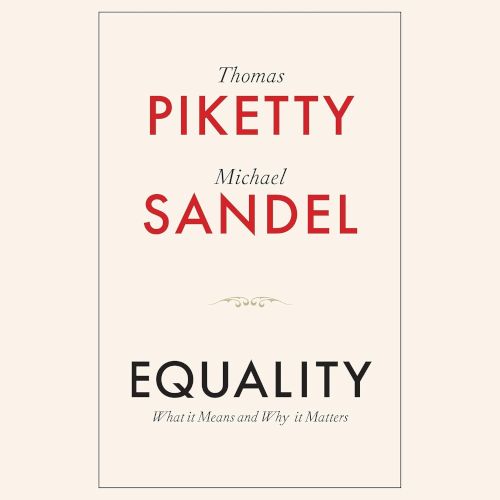
When I chose this book for review, I expected a large tome to arrive and was prepared for a long spell reading, learning and then reviewing. Instead, I received a small book, basically consisting of a discussion on equality Thomas Piketty had at the Paris School of Economics where he teaches with Harvard Professor Michael Sandel. Consequently, I assumed that it would be easy and quick and I would be able to review it in no time at all. But no – it is dense with all sorts of ideas advanced between them on equality and how to deal with it, agreeing on some points, disagreeing on others and raising serious questions on the various efforts by different countries and different political movements on progress in efforts to ensure that growth and prosperity was shared by all – and in a fair way.
So, what are the issues? Unequal distribution of income and wealth is well known. The US is the most unequal in the G7. In Europe the richest 10% of the population earn 30% of all the income and own 50% at all the wealth. The UK is not very dissimilar and languishes 34th in the OECD inequality list of 38 countries. But when education such as length of schooling is added, the UK’s ranking in the UN’s HDI index is a slightly more respectable 13th. Still not good enough, one guesses, for the 5th largest economy in the world.
And yet Piketty starts his part of the discussion pointing out the substantial progress in equality over the last two hundred years, helped by what he identifies as an “appetite for democratic participation and self- government”. But, clearly, we have further to go. In Sandel’s view we don’t value health, education and cultural activities appropriately and hence the various agents who contribute to those activities are not properly rewarded. They rail against meritocracies as those who benefit from it then assume a perpetual right in enjoying the benefits looking down on the rest. And benefiting from the wealth of your parents and enjoying legacy privileges through life also accentuates and entrenches those inequalities.
The opening up of markets has brought its own problems. They both suggest the need to control what Sandel refers to as hyper-globalisation and trade agreements which allow free movement of capital and goods and financialisation of economies. They worry that the inequalities they create bring in their wake the growth of right-wing populism with its unintended consequences. Not surprisingly, Trump’s name makes an appearance.
So, what to do? If they were to choose what to control they would go for restricting capital flows, also possibly trade flows, but not immigration. Piketty also highlights as an issue the demolition, as he calls it, of progressive taxation started by Reagan forty years ago and followed by most Western nations since. And they use evidence from places like Sweden that countries did perfectly when tax rates were considerably higher.
But in essence the argument seems to be that faith in the markets to do the job for us – and “spare us from debating and deciding contested questions about the common good” – is misplaced. They both believe that this comes from a fear of democracy and of democratic deliberation. They seem to want to see a way to tackle the “Wall Street kind of ideology about globalisation, financialisation (and) meritocracy” , possibly replacing it with a sort of democratic socialism with non-distorting financial incentives in the provision of public services, including in health and education , and considerably stronger worker representation on company boards to widen involvement and participation in the decision making process across the economy.
It’s worth finishing by summarising what the two discussants mean when they talk about equality, and hence their general prescriptions. It’s not just about economic equality relating to the distribution of income and wealth. This is certainly one aspect, but only one. The second one is political equality in terms of having voice and power and ability to participate. And the third is about what they define by using words such as ” dignity”, “status”, “respect”, “recognition” and “esteem”. For them, the third seems a prerequisite for reducing inequality in the other two. An interesting way of thinking about such a wide topic.